
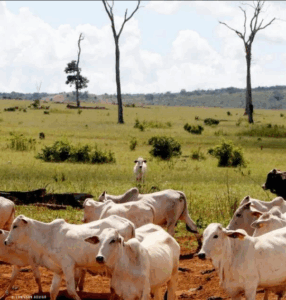
Report say illegal logging, hidden ownership structures, and weak transparency laws are depriving governments of badly needed climate and biodiversity financing. Credit: Financial Transparency Coalition
By Umar Manzoor Shah
SRINAGAR, India, Jun 8 2026 – A new report has found that billions of dollars linked to illegal deforestation are flowing through global supply chains, with secrecy around land ownership and company records helping timber, soy, and beef products enter international markets unchecked.
The report, Financial Secrets of the Forests: How Secrecy Fuels Deforestation in Brazil and Cameroon, was released by the Financial Transparency Coalition in partnership with the Center for Economics and Finance for Latin American Development (CEFILAT) on May 26, this year, examined forest loss and illicit financial flows in Brazil and Cameroon, two countries that hold some of the world’s largest tropical forests.
Researchers behind the report say illegal logging, hidden ownership structures, and weak transparency laws are depriving governments of badly needed climate and biodiversity financing. They argue that while countries have passed anti-deforestation laws, the lack of public access to company ownership records allows those benefiting from environmental destruction to remain hidden.
The report estimates that trade mispricing linked to timber exports cost Cameroon an average of US$289 million every year between 2013 and 2023. In Brazil, unexplained discrepancies in timber exports amounted to around US$214 million over a similar period.
When asked whether the report argues that financial secrecy is central to illegal deforestation and what the biggest obstacles were faced while trying to identify the real beneficiaries behind timber, soy, and cattle businesses in Brazil and Cameroon, one of the report’s lead authors, Matti Kohonen, Executive Director of the Financial Transparency Coalition, told Inter Press Service (IPS) in an exclusive interview that they weren’t able to identify the beneficial owners of these businesses despite using the best available data, including satellite GIS data.
“For the state of Mato Grosso in Brazil, which represents a fifth of the country’s total deforestation, we identified hundreds of thousands of plots of land which had been illicitly deforested from 2010 to produce soy and cattle but could only find the ID of the plots and, in some cases, companies behind them, but not their beneficial owners. When we asked the local authority for this information for the top plots of land, they replied this could not be provided due to privacy concerns despite this being a clear example of a public interest request,” he said.
“For Cameroon, on the other hand, we focused on timber and were able to map the main timber concessions (Forest Management Units (FMUs) and Sales of Standing Volume (SSVs), described in the report) and the companies that had these concessions were mostly identifiable in the datasets, but we could not find out using the best data whether these were shell companies owned by foreign firms and also could not identify their beneficial owners.”
According to him, Cameroon does have a BO database, but this is not publicly accessible. Matti said that there is some data on mining and fossil fuel companies through the EITI (extractive industries transparency initiative), but forestry is not in their scope.
“When we asked for this information from the Cameroonian government, we didn’t get any reply, not even about the updated list of sanctioned timber companies, which we actually found were still being given concessions as late as July 2025. Some of these sanctioned timber companies were available online, but not for the most recent years and there was no historical data that we found through earlier reporting by Pulitzer.”
The findings suggest that existing international regulations are failing to stop products linked to deforestation from entering global markets. Matti said that the biggest enforcement gaps in producer countries or importing countries are the inability to identify the companies and their beneficial owners responsible for deforestation and the lack of transparency in the supply chains which prevent tracing products to the source.
“This is a good study by WRI highlighting these issues. Another key problem is the lack of political will to tackle these issues. This is reflected in our report in the case of Cameroon, whose authorities didn’t provide us with any data, as well as the state of Mato Grosso, which refused to reveal the beneficial owners of the top plots of land linked to illicit deforestation despite the freedom of information legislation in Brazil.”
Matti added that the lack of publicly available beneficial ownership registries is a key problem as well, preventing NGOs and journalists from finding out those benefitting from the illicit clearing of forests.
“From the importing countries, the lack of political will to stop products from deforested land from entering global markets is also a major problem, especially now in major importing countries like China and Vietnam, which keep importing these products from companies that have been denounced and sanctioned in the past, as we see in Cameroon. That’s why we’re saying that without financial ownership and supply chain transparency it’s largely impossible for initiatives such as EUDR to succeed.”
The report argues that forests are not only being destroyed by chainsaws and fires, but also by opaque financial systems that make it difficult to identify who profits from deforestation.
“Financial and land ownership secrecy is a key driver behind illicit deforestation,” the report states.
In Brazil, investigators focused heavily on Mato Grosso, a state known as one of the world’s largest hubs for soy and cattle production. Satellite data showed that from 2010 to 2023, vast stretches of land were cleared without proper permits. Researchers found that 48 percent of soy production areas and 15 percent of intensive grazing pasture overlapped with plots lacking deforestation permits.
The environmental impact has been severe. Illegal cattle grazing linked to deforestation in Mato Grosso produced an estimated 502 million tonnes of carbon dioxide emissions between 2001 and 2023. Soy cultivation linked to illegal forest clearing generated another 250 million tonnes of emissions during the same period.
Researchers say tracing responsibility is extremely difficult because ownership information is often hidden or inaccessible.
Brazil maintains land and environmental registries, but public access to the real individuals behind companies and land holdings remains restricted. Investigators said even official requests under Brazil’s transparency laws failed to reveal the identities of people linked to illegally cleared land.
One case study highlighted a massive ranch in Mato Grosso called Fazenda Santa Silvia, where more than 3,000 hectares were allegedly cleared illegally between 2022 and 2023. Investigators connected the property to companies involved in soy and cattle production and traced supply chain links to meatpacking giants including JBS and Marfrig.
“We only analysed Mato Grosso but this state we strongly believe reflects the reality across Brazil, so the fact that such a large percentage of land for soy and beef has been illicitly deforested is really concerning. Afterwards, some of these plots get permission to grow soy/pasture but the literature suggests they’re the minority and doesn’t replace the fact that they were illicitly deforested in the first place,” Alfonso Daniels, lead author, said.
“Our data appears to reflect global research done by NGOs, such as a report from the NGO Forest Trends a few years ago that found that at least 69% of tropical forests cleared for agricultural activities such as ranching and farmland between 2013 and 2019 was done in violation of national laws and regulations, with other research showing similar percentages,” he added.
The report says such investigations currently depend on time-consuming fieldwork by journalists and environmental groups because public databases do not reveal beneficial ownership details.
The Congo Basin rainforest, where Cameroon is located, is the second largest rainforest system in the world after the Amazon. Cameroon lost more than 100,000 hectares of forest in 2025 alone, producing an estimated 130 million tonnes of carbon emissions.
Researchers found large discrepancies between the value of timber exports reported by Cameroon and the import figures recorded by trading partners such as China, Vietnam, and European Union countries. Between 2013 and 2023, the trade gap reached US$1.2 billion with China and US$760 million with Vietnam.
The report says this may point to underreporting of exports to evade customs duties and taxes.
Cameroon has introduced reforms requiring companies to disclose beneficial ownership information to tax authorities. However, the registry is not public, making it difficult for watchdog groups and journalists to track who ultimately controls logging companies and forest concessions.
Investigators also found that some companies sanctioned for illegal logging continued receiving logging permits years later. One table in the report lists several firms that were granted new concessions even after being penalized by authorities.
Environmental groups say weak enforcement in importing countries is adding to the problem.
Although the European Union, United Kingdom, and United States have laws banning illegal timber imports, the report argues that companies linked to deforestation continue accessing major markets because ownership structures remain hidden.
The European Union’s new Deforestation Regulation, expected to take effect in late 2026, will ban products linked to recently deforested land. But researchers warn that enforcement will remain difficult unless governments make ownership records fully public.
The report has pitched for public beneficial ownership registries, stronger supply chain transparency, public databases on environmental crimes, and a global asset registry that would reveal who owns forests, farmland, and logging concessions worldwide.
Researchers argue that tackling climate change and biodiversity loss will require more than promises to protect forests. They say governments must also confront the financial secrecy systems that allow environmental crimes to remain profitable.
The report estimates that money lost through illegal logging, tax evasion, and hidden financial flows could help close major global funding gaps for forests, biodiversity, and climate action.
When asked why Cameroon and Brazil both have beneficial ownership registries, yet public access remains limited and why governments continue to resist transparency around land and company ownership despite the environmental stakes, Daniels said that the laws that established these beneficial ownership registries are narrow in their scope concerning the use of the data, often such registries are made in compliance with the Financial Action Task Force (FATF) recent changes in its recommendations 24 and 22 that now require government-run and centralised beneficial ownership registries for anti-money laundering purposes.
“In the case of Cameroon, they are on the FATF grey list and establishing a high-quality and centralised government-run registry gets them off that list, and that’s one of the motivations to establish a BO registry, but there is no requirement to make it public under existing frameworks.
“Only in the case of extractive industries defined as mining and oil/gas do we have the requirement, as Cameroon is a signatory to the Extractive Industries Transparency Initiative (EITI) and they should comply with its requirement for public access, and some data on these is publicly accessible, but forestry is not considered an extractive industry and is outside of its scope,” said Daniels, adding that also, public pressure thus far from inside the country has not made this data fully public for any other reason.
“In the case of Brazil, the federal tax authority runs the beneficial ownership registry established before the FATF rule to comply with the OECD information exchange provisions from 2016 onwards, largely for tax collection reasons,” Daniels said.
According to him, the data is shared also with anti-corruption authorities to comply with later FATF rules. However, Daniels said that this data is not made public. “As Brazil is not a member of the EITI, it also does not make this data public even in the scope of mining, oil and gas companies. There isn’t enough internal pressure from any section of society to make BO registries public, even if this could tackle illicit logging that is a major political concern for the current presidency.”
According to Kohonen, illicit financial flows linked to illicit deforestation can arise at different stages. “If logging takes place without the proper licences, it is considered illegal, and the whole value of timber is therefore illicit. It is important to ensure that sanctions and fines are promptly administered to deter anyone from illegal logging, but currently it is still far too commonplace that land is illegally logged, as up to 30% of all timber comes from land that was illegally logged. This is an enforcement gap, where you can automatically issue sanctions and fines to companies that, based on satellite data, have deforested without adequate licences,” said Kohonen.
“Another stage is at the point of exporting (some 10-15% of all timber in Brazil is exported; the domestic consumption is quite high, while in Cameroon, most of the timber is exported), so at this point, the customs authorities could be checking if the timber is correctly valued at the point of export and if there are irregularities in customs declarations that may then lead to trade mispricing (unexplained value gaps between the export at the source and import prices at the destination country).”
He added that finally, there are also issues with tax authorities, where mispriced timber is often also a case of tax evasion, if this leads to paying less in VAT, royalties or export taxes. Also, according to Kohonen, companies may misdeclare their corporate taxes if they don’t report adequate sales of timber or wood products or if they don’t declare their products grown on deforested land correctly (e.g., soy/beef).
“Finally, companies may engage in profit-shifting activities, where they move taxable profits to offshore tax havens where they are taxed at a lower rate or may attract tax exemptions, or profits could be moved to tax havens through intra-firm transfers that are mispriced (e.g., mispriced internal financing or internal use of brand or IP). These all contribute to making deforestation and deforestation-linked commodities more profitable and less likely to be detected.”
IPS UN Bureau Report
!function(d,s,id){var js,fjs=d.getElementsByTagName(s)[0],p=/^http:/.test(d.location)?’http’:’https’;if(!d.getElementById(id)){js=d.createElement(s);js.id=id;js.src=p+’://platform.twitter.com/widgets.js’;fjs.parentNode.insertBefore(js,fjs);}}(document, ‘script’, ‘twitter-wjs’);



 Lebanese Pound Exchange Rate